


Why your hospitality internship CV should be readable in 30 seconds
An internship abroad means discovering a new country, a new language and a team from all over the world. But it all starts with one document: your hospitality internship CV. It’s what makes a hotel want to meet you.
Recruiters often spend less than a minute on a CV. Yours should fit on a single page and be readable in 30 seconds. At a glance, the hotel should find your school, your specialisation, your languages and your internship dates.
The two sections hotels look at most are education and languages. They must be complete and easy to spot. For the layout, Canva’s free templates are a good starting point: pick a simple template with few colours.
The order of the sections
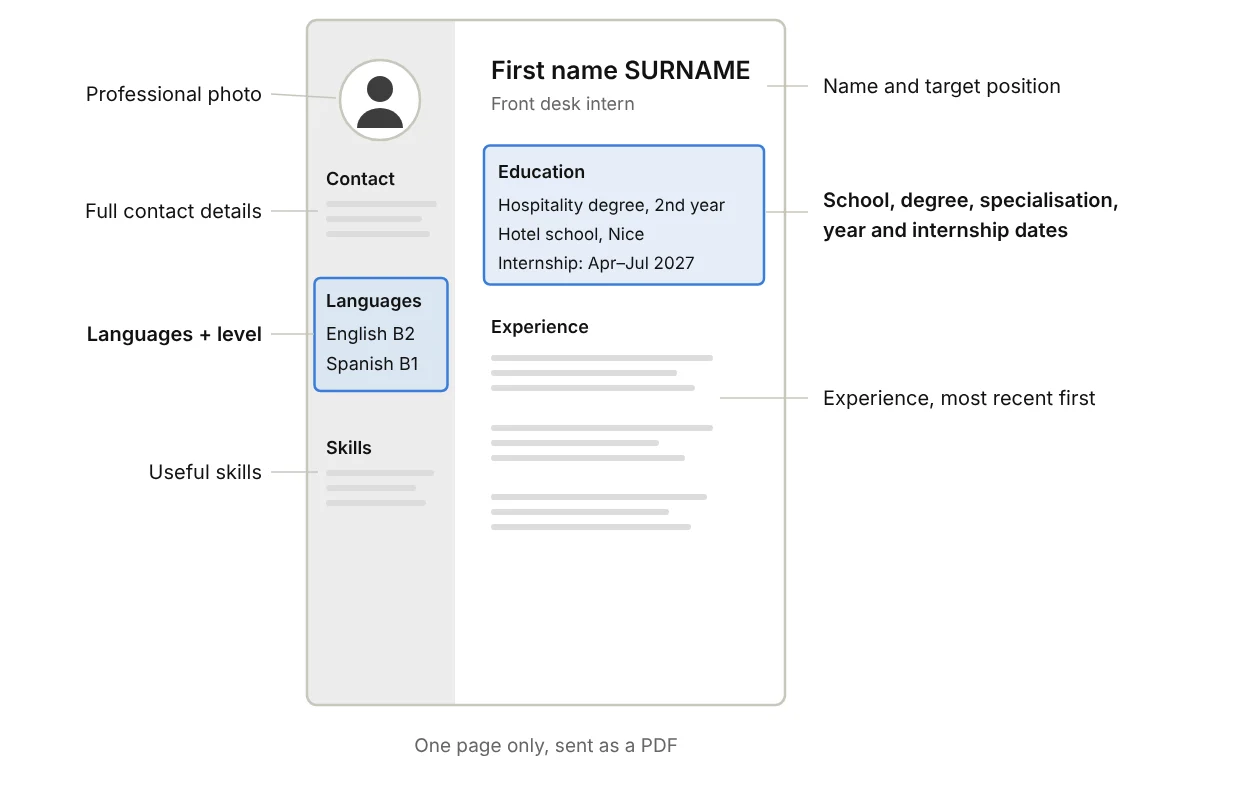
Write your CV in this order, from top to bottom:
- Header: first name, surname, photo and target position.
- Contact details: phone, email, city.
- Education: your current studies first.
- Experience: from the most recent to the oldest.
- Languages: with your level, from A1 to C2.
- Skills: software and personal qualities.
- Interests (optional): two or three, on one line.
Still a student? Put your education before your experience. It’s what justifies your internship application.
1. Your personal details
- Your first name and surname in large type, at the top of the page.
- Your phone number with the country code (+1, +44…), a professional email address (firstname.surname@…) and your city.
- A professional photo: neutral background, smart outfit, smile. No selfies or holiday photos.
In hospitality, the photo matters. It gives the recruiter a first idea of how you would present yourself to guests.
2. Your education: be specific
The hotel must understand at a glance what you’re studying. For your current studies, include:
- the full name of your school and its city;
- the degree you’re studying for: Bachelor’s, Associate degree, Master’s…;
- your specialisation: hotel management, tourism, languages, business…;
- your current year: 1st, 2nd or 3rd year.
Example: Bachelor’s in Hospitality Management, 2nd year – [School name], Nice (2025-2027). 4-month internship from April 2027.
Your internship dates are essential. Hotels plan their season well in advance: they need to know straight away whether your availability matches their needs.
3. Your languages: use the European levels
Avoid “good level” or “basic knowledge”. State your level using the Common European Framework of Reference for Languages (CEFR), which every hotel understands. Be honest: your level will be checked during the interview.
| Level | What you can do |
|---|---|
| A1 – Beginner | Introduce yourself, understand very simple sentences |
| A2 – Elementary | Talk about everyday, familiar topics |
| B1 – Intermediate | Get by at work, give a guest simple information |
| B2 – Upper intermediate | Converse with ease, handle most guest requests |
| C1 – Advanced | Express yourself fluently and precisely |
| C2 – Proficient | Speak like a native speaker |
Example: English: native · Spanish: B2 · French: A2.
Add your certificates if you have any (TOEFL, IELTS, DELE…). To assess your level, the official grid is available on the European Union’s Europass website. Thinking of taking a test? Find out which English tests to take and which Spanish test to choose for your internship.
4. Your experience and skills
- Your experience, from the most recent to the oldest: position, establishment, city and dates (month and year).
- Two or three tasks per experience, with action verbs: “Welcomed guests”, “Managed bookings”.
- Small jobs count: restaurant work, retail, entertainment or babysitting show your sense of service.
- A few useful skills: software (Opera PMS, Word, Excel) and qualities (punctuality, teamwork).
Have you travelled, volunteered or lived abroad? Mention it. International hotels value open-minded profiles who feel at ease with other cultures.
5. Mistakes to avoid
- A CV longer than one page.
- Spelling mistakes: have your CV proofread.
- A vague school or specialisation, with no year or degree.
- Languages without a precise level.
- A jokey email address or an unprofessional photo.
- A Word file: always send a PDF named CV_Firstname_Surname.pdf.
Your CV, your passport to international hospitality
One last reflex: write your CV in the language of the country. In English for an internship in Greece or Malta, in Spanish for an internship in Spain. To adapt your layout for abroad, also follow our guide on how to write a CV for abroad.
A clear, precise and honest hospitality internship CV is the first step towards an experience that matters: working in a hotel, improving another language and meeting people from all over the world. Find out why doing a hospitality internship abroad is an excellent opportunity.
Is your CV ready? The next step is the interview: our 5 tips for your international internship interview will help you prepare.